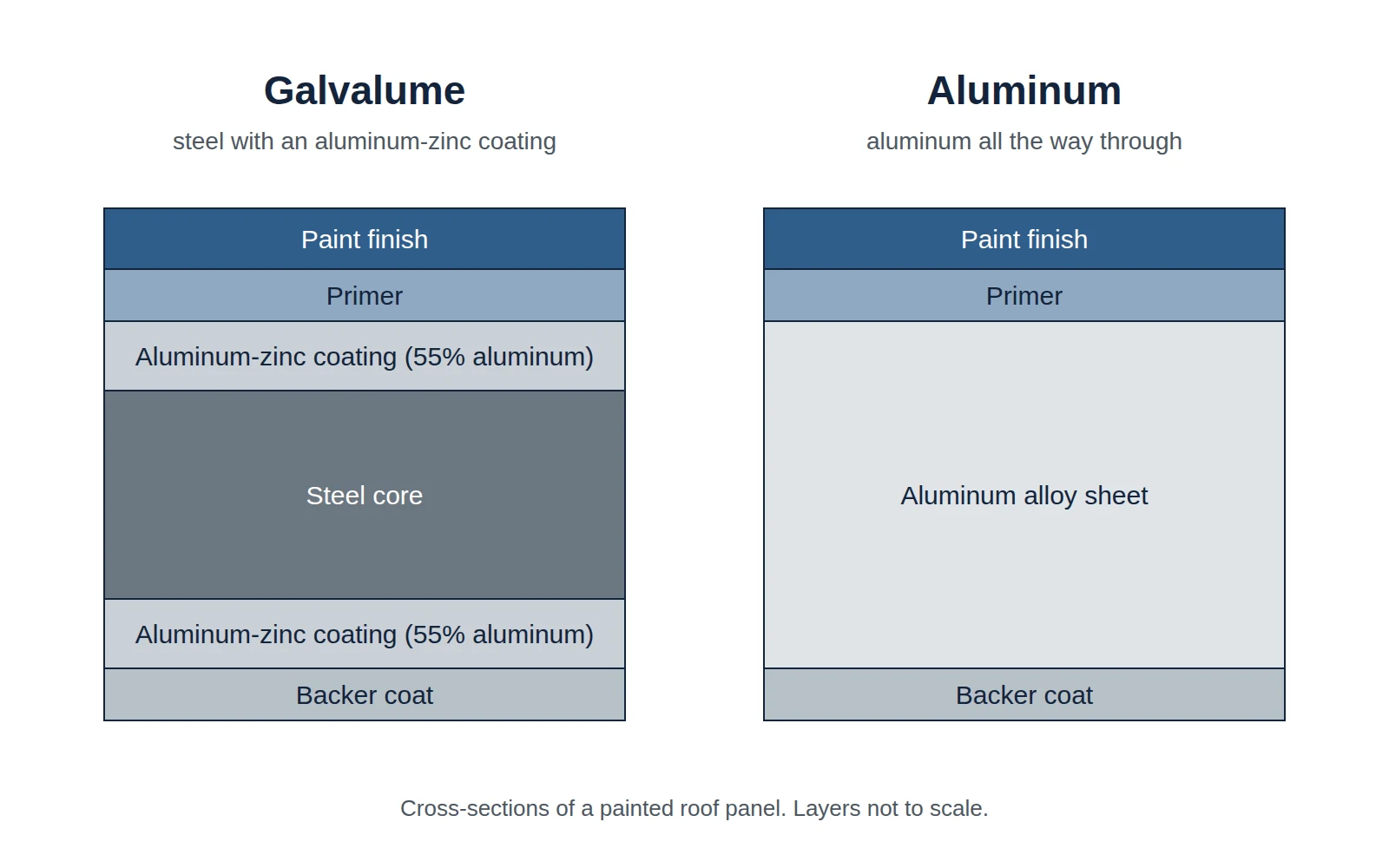
Galvalume vs aluminum roof is the material choice behind most metal roof quotes, and in the Houston area it usually comes down to one question: how close is the building to salt water? Galvalume metal roofing is steel sheet with a 55% aluminum-zinc alloy coating. Aluminum roofing is solid aluminum alloy sheet. Steel costs less and resists dents better; aluminum handles salt air better. RISE Roofing installs both, aluminum as standing seam only. Here is how they compare.
Galvalume is steel coated by the hot-dip process with a 55% aluminum-zinc alloy, made to ASTM A792. Wheeling-Nippon Steel, which produces it, says the coating "combines the excellent barrier corrosion protection of aluminum with the galvanic protection of zinc." It comes in AZ50 or AZ55 coating weights; one supplier uses AZ50 under paint and AZ55 for unpainted panels.
Houston's adopted residential code sets AZ50 as the minimum for this coating on steel roof panels (2021 IRC as adopted by Houston, Table R905.10.3(2)). Steel is sold by gauge, and residential panels are generally 24 to 26 gauge; our gauge guide explains the numbers.
Galvanized steel has a zinc-only coating (ASTM A653; the code minimum is G90). Galvalume adds aluminum, and Wheeling-Nippon states its corrosion resistance "far exceeds that of galvanized steel sheet." The code accepts both. Over livestock, though, one steel coil maker recommends galvanized or stainless instead of Galvalume, because animal waste attacks the aluminum-zinc coating; see barn and shop metal roofing. If a quote just says "galvanized" or "Galvalume," ask for the designation in writing: G90, AZ50 or AZ55.
Aluminum panels are formed from aluminum alloy sheet made to ASTM B209 and need no metallic coating: the Metal Construction Association (MCA) notes that aluminum alloys "quickly form oxide layers," and a panel maker's article calls aluminum "corrosion-resistant by nature." Roofing alloys include 3004 and 3105; Metal Sales' Florida product approval for its aluminum Classic Rib panel, for example, lists "3004-H14 or 3105-H24 Alloy (ASTM B209)."
Aluminum is sold by decimal thickness, not gauge. One maker's snap-lock standing seam comes in .032 or .040 aluminum, or 24 or 22 gauge steel, and Houston's residential code sets 0.024 inch as the minimum for roll-formed aluminum panels.
| Galvalume steel | Aluminum | |
|---|---|---|
| What it is | Steel with a 55% aluminum-zinc coating (ASTM A792) | Aluminum alloy sheet (ASTM B209) |
| Corrosion protection | The metallic coating protects the steel | Corrosion-resistant by nature |
| Near salt water | Warranties we checked exclude salt-water air; some set minimum distances | Can be warranted closer in, with conditions such as a yearly rinse |
| Dents and hail | Resists denting better | More prone to denting |
| Weight | Heavier | Lighter |
| Heat movement | Less | Almost twice as much as steel |
| Thickness sold as | Gauge (residential: generally 24 to 26) | Decimal inches (such as .032 or .040) |
| Finish | Bare, SMP paint or PVDF paint | Almost always painted, often PVDF |
| Profiles | Standing seam, R-panel, 5V crimp, corrugated | Standing seam; 5V and corrugated as options; rarely R-panel |
| Price | Lower | Higher |
This is where the two metals split. The Galvalume warranties we checked exclude salt-water exposure, and some put the line in feet:
The same maker's aluminum warranty still applies inside those distances, with a shorter substrate term and a condition: the owner must rinse the whole roof system, soffits and eaves with fresh water every year and keep records. Aluminum handles salt better, but it isn't maintenance-free near the water.
Both documents also exclude corrosion from chemical fumes; Nucor names chemical plants and oil refineries. Every maker writes its own terms, so before you sign, read the actual warranty for the panel on your quote. Our metal roof warranty guide explains the layers of coverage.
Most homes and buildings in Houston, Katy, Cypress, Tomball, Conroe and The Woodlands sit miles from salt water, far outside clauses like these. There, Galvalume's lower price and dent resistance usually make it the practical pick.
Close to Galveston Bay and the tidal water connected to it, measure the distance and check it against the panel maker's warranty before choosing steel. That is where aluminum's warranty terms can decide it.
Much of the bay shore is also in TDI's designated catastrophe area for windstorm coverage: the 14 first-tier coastal counties, plus, in Harris County, the parts of La Porte, Morgan's Point, Pasadena, Seabrook and Shoreacres east of State Highway 146. There a new roof needs a windstorm inspection and certificate for TWIA coverage, with limited exceptions. Where RISE re-roofs inside that area, we handle the permit paperwork, including the Texas windstorm (WPI-8) paperwork, and require a tear-off. See our windstorm metal roof guide.
Aluminum is the softer metal. A panel maker's article puts it plainly: "Aluminum is more prone to denting than steel," and in high hail-risk regions steel is often recommended, with thicker gauges resisting dents better still. If hail worries you more than salt air, Galvalume is the safer choice. Aluminum is lighter, which can matter on an older or lightly framed structure.
Another panel maker's article says aluminum "will expand and contract almost twice as much as steel": over a 100°F swing, a 30-foot aluminum panel can move about 7/16 inch, against about 1/4 inch for a similar steel panel. Long runs need floating clips or slip joints, which is why the clip system on a standing seam roof matters. On exposed-fastener panels, thermal movement is one reason screws back out over time.
Galvalume can be installed bare or painted. Bare Galvalume varies in spangle and shade from coil to coil and can weather to different shades; Nucor's color chart says that is "not cause for rejection." On painted Galvalume, SMP is the harder, more scratch-resistant finish, and PVDF is the fluoropolymer finish known for weather and UV resistance, at a slight upcharge. "Pre-weathered Galvalume" is a paint color, not bare metal: one steel supplier lists it among its PVDF metallic colors.
Aluminum is almost always painted, and the color list can be shorter: one maker's chart shows 44 colors in 24-gauge steel, 30 in .032 aluminum and 24 in .040. See metal roof colors for how color affects heat and fading.
MCA's bulletin on dissimilar-metal corrosion gives these rules, and the panel makers' warranties back several of them:
Aluminum. A panel maker's article states it simply: "Aluminum is more expensive than steel." On Galvalume, PVDF paint costs a little more than SMP, and thickness and profile move the price too. For Houston ranges, see our metal roof cost guide. Whichever metal you pick, the metal and paint warranties come from the panel maker, and RISE's 10-year workmanship warranty covers our installation.
Galvalume is steel sheet coated with a 55% aluminum-zinc alloy by the hot-dip process, made to ASTM A792. For roofing it usually comes in AZ50 or AZ55 coating weights and can be installed bare or painted.
For most roofs, yes. Galvanized has a zinc-only coating; Galvalume adds aluminum, and one producer says its corrosion resistance far exceeds galvanized. Houston's residential code accepts both. Over livestock or other animal confinement, one steel coil maker recommends galvanized or stainless steel instead.
The coating protects the steel, but salt air, copper or lead runoff, treated lumber, wet mortar and graphite pencil marks can attack it, and the steel underneath can then rust. The warranties we checked exclude salt-water air and lead or copper runoff, among other conditions.
Yes. A panel maker's article calls aluminum extremely resistant to seawater corrosion, while Galvalume warranties such as Nucor's exclude salt-water air. Near the water, an aluminum warranty may still require a yearly fresh-water rinse.
Yes. Aluminum is more expensive than Galvalume steel, and thickness, panel profile and paint system also move the price.
Yes. Aluminum is softer, and a panel maker's article says it is more prone to denting than steel. Where hail matters more than salt air, Galvalume steel is the better fit.
Weighing Galvalume against aluminum for a home or building in the Houston area? Call (832) 345-9527 or use the form for a written quote in 24–48 hours, price-locked once you sign.
Industry reference: Metal Roofing Alliance.
No waiting around for multiple contractors to come bid your roof. One quick call is all it takes.
Pick any slot that works for you — online and instant.
Free video or voice call. We answer your questions and gather what we need.
We email your price-locked quote — no pressure, no sales visit.
🔒 Free, no-obligation estimate — Price-locked in 24–48 hrs