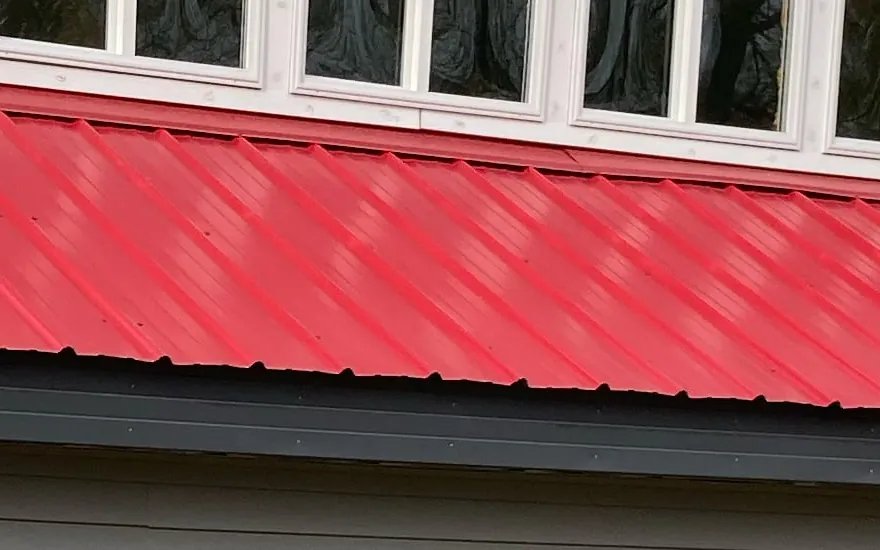
Every metal roof uses one of two fastener systems: exposed fastener (screws driven through the panel face, visible on the surface) or concealed fastener (clips or fasteners hidden under the panel seams, also called "hidden fastener"). The exposed vs concealed fastener choice affects cost, lifespan, maintenance, and how the roof copes with Houston heat and heavy rain.
R-panel, corrugated, and 5V crimp all use exposed screws with rubber (EPDM or neoprene) sealing washers. Panels lap over each other and are screwed straight through the face into the purlins or deck. On R-panel that typically means #10 or #12 self-drilling screws set in the flat beside the major ribs, about 12" apart across the panel at each purlin. The washer is the only thing sealing each hole, so technique matters: the Metal Construction Association recommends a screw gun with an adjustable clutch or depth-sensing nosepiece, not an impact driver, and warns that overdriven screws damage the washer and can leak.
Pros: lower cost ($4.50-$8.50/sqft), faster installation, easy to repair. Cons: screws can back out over time from thermal expansion, the rubber washers degrade in UV and heat (every 10-15 years), and every screw hole is a potential leak point.
On a concealed fastener metal roof, nothing goes through the panel face. With standing seam, clips are fastened to the deck along each panel edge and the raised seam locks over them, either snapped together (snap-lock) or folded with a seaming tool (mechanical seam). A lower-cost variant uses a nailing flange hidden under the next panel's overlap; it still counts as concealed, but the leak path back to the fastener is shorter. Some stone coated steel systems also hide all their fasteners.
Pros: no screw holes in the panel field, cleaner aesthetics, longer lifespan (50-70 years for standing seam), and panels float on clips, allowing thermal expansion without stress. Cons: higher cost ($9-$16/sqft), requires specialized installation. RISE installs both snap-lock and mechanically seamed standing seam and offers on-site roll forming.
| Exposed fastener | Concealed fastener | |
|---|---|---|
| Common profiles | R-panel, 5V crimp, corrugated | Standing seam; some stone coated steel |
| How it attaches | Screws through the panel face, each with a sealing washer | Clips or a hidden nailing flange under the seams |
| Installed cost | $4.50-$8.50/sqft | $9-$16/sqft (standing seam $9.00-$14.00; stone coated steel $12.00-$16.00) |
| Thermal movement | Pinned at every screw; movement works on screws and washers | Panels slide on clips |
| Main leak points | Every screw hole, plus the laps | Flashings, valleys and penetrations |
| Routine upkeep | Washer and screw checks; washers degrade every 10-15 years | No scheduled re-seal |
| Lifespan | 25-45 years by profile (corrugated 25-40, R-panel 30-40, 5V 35-45) | 50-70 years (standing seam); 50+ (DECRA stone coated steel) |
| Best fit | Barns, shops, warehouses, carports, budget projects | Homes, HOA neighborhoods, low-maintenance owners |
Exposed fastener: every screw hole is a potential leak point. The usual failures:
Concealed fastener: with no holes in the panel field, leaks come from the details: flashing at chimneys and dormers cut short or back-caulked, valley flashing without a center W-bend, skipped peel-and-stick at penetrations, or a mismatched clip that breaks the sealant inside a seam.
The Metal Construction Association's standing seam clip guide notes panel temperatures can swing more than 150°F in a single day, and 100°F within minutes when a cool rain hits a sun-baked roof.
An exposed fastener panel is pinned at every screw, so that movement works on the screws and washers and, over the years, backs screws out and loosens the seal. Overdriven screws make it worse by restricting movement, which can cause the waviness known as oil canning.
A concealed fastener panel moves on its clips instead. One-piece clips are fixed to the deck and suit shorter panels; two-piece sliding clips, whose top half travels with the panel, are common on longer runs. Each panel still needs a fixed point so it moves in a controlled direction. Long panel runs are also a reason to step up to 24 gauge (see the gauge guide).
Exposed fastener: plan on washer and screw checks for the life of the roof. When the washers wear out, the fix is a fastener pass: walk the whole roof, find backed-out or crushed screws, and replace the screws with the next size up (a #12 becomes a #14) and fresh EPDM washers. RISE re-seals fasteners on aging R-panel and 5V crimp roofs.
Concealed fastener: no water path to a fastener and no scheduled re-seal. Flashings, valleys and pipe boots still deserve a look, and any new penetration (an HVAC curb, a solar mount) should be flashed by a metal roofer.
Installed, exposed fastener systems run $4.50-$8.50/sqft and concealed fastener systems $9-$16/sqft: standing seam runs $9.00-$14.00/sqft and stone coated steel $12.00-$16.00/sqft. The gap pays for clip layout along every panel, snapped or machine-folded seams, flashing fabrication, and a crew with seaming tools and skills most shingle crews don't have.
Fastener passes narrow the gap over time, but commercial owners who budget that upkeep usually still come out ahead with exposed fastener; homeowners who want to set and forget the roof usually do better with concealed fastener despite the higher day-one cost.
Choose exposed fastener for commercial and agricultural buildings, budget-priority projects, and applications where maintenance access is easy. Choose concealed fastener for residential homes, premium durability, and anywhere long-term leak prevention is critical. It is also the safer pick in HOA neighborhoods, since almost no Houston HOA approves visible exposed fastener panels.
In the Texas windstorm (TDI catastrophe) area, either system must be engineered for local wind loads, and the windstorm inspector checks that the clip or screw spacing matches the tested wind-uplift assembly (see Texas windstorm metal roofs). Whichever you choose, RISE's 10-year workmanship warranty covers our installation, and panel and paint warranties come from the manufacturer (see the warranty guide). Ask for a written quote to compare both on your building.
A concealed (or hidden) fastener metal roof attaches its panels with clips or a nailing flange tucked under the seams, so no screw goes through the panel face. Standing seam is the common example.
Pros: lower cost, faster installation and easy repairs. Cons: every screw hole is a potential leak point, the washers degrade every 10-15 years, and thermal movement can back screws out.
Exposed fastener systems (R-panel, 5V crimp, corrugated) run $4.50-$8.50/sqft installed. Standing seam runs $9.00-$14.00/sqft, and stone coated steel $12.00-$16.00/sqft.
The washers degrade every 10-15 years in Houston's heat and UV. The fix is a fastener pass: find backed-out or crushed screws and replace the screws with the next size up and fresh EPDM washers.
For most homes, yes: no exposed screw holes, no scheduled re-seal, and a 50-70 year lifespan for standing seam. Exposed fastener makes more sense on barns, shops, warehouses and budget outbuildings.
Industry reference: Metal Roofing Alliance.
No waiting around for multiple contractors to come bid your roof. One quick call is all it takes.
Pick any slot that works for you — online and instant.
Free video or voice call. We answer your questions and gather what we need.
We email your price-locked quote — no pressure, no sales visit.
🔒 Free, no-obligation estimate — Price-locked in 24–48 hrs