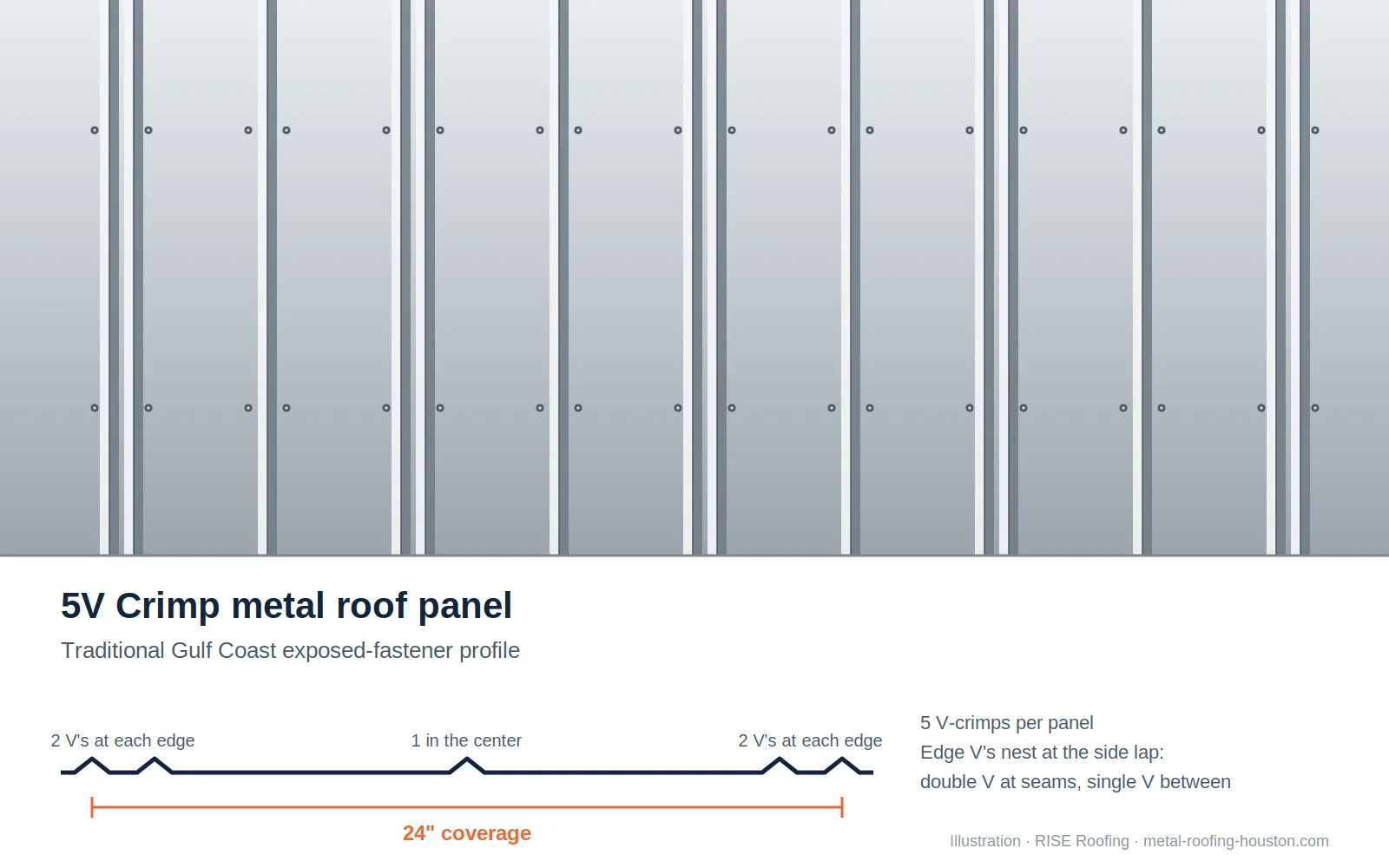
5V crimp is an exposed-fastener metal roof panel that covers 24" and takes its name from its five V-shaped crimps: two at each edge and one in the center. Where panels lap, each edge pair nests with the neighbor's, so the finished roof shows a double V at every seam and a single V halfway between. The ribs are low (1/2" on published 5V spec sheets), so the roof reads as flat panels with crisp lines rather than the tall ribs of a warehouse roof. 5V goes over a solid deck at a 3:12 pitch or steeper, and its traditional look suits older homes and farmhouses.
It is the traditional Gulf Coast metal profile, and it suits the older homes in the Heights, the Old Sixth Ward and Houston's other historic neighborhoods. The geometry was developed in the 1880s and the design hasn't needed to change.
RISE Roofing's installed pricing for 5V crimp runs $5.50–$8.50 per square foot. A 2,000 sq ft Houston home lands at $11,000–$17,000 fully installed.
Where a roof lands in that range depends on gauge (26 vs 24), finish (bare Galvalume or a painted color), and whether the deck needs new sheathing first. R-panel's installed range starts a little lower; standing seam costs more.
More on thickness in the gauge guide, and on screws vs clips in exposed vs concealed fasteners.
Both are exposed-fastener panels that cost less than standing seam. The differences are what they sit on, how flat a roof they can handle, and how they look from the street.
| Factor | 5V | R-panel |
|---|---|---|
| Coverage per panel | 24" | 36" |
| Rib height | 1/2" | 1.25" major ribs, 12" on center |
| What it sits on | Solid wood deck | Built to span purlins (PBR = "Purlin Bearing Rib") |
| Minimum pitch | 3:12 | 1/2:12 with sealant in the laps |
| Fasteners | Exposed screws with sealing washers | Exposed screws with EPDM washers |
| Typical use | Homes, historic restorations, farmhouses | Warehouses, barns, shops, carports |
| Installed price at RISE | $5.50–$8.50 per sq ft | Starts a little lower |
In short, R-panel is the workhorse for warehouses, barns and shops; 5V is the residential panel. For the round-wave barn look, see corrugated.
Standing seam hides its fasteners under raised seams, so no screw goes through the panel face and there are no washers to re-seal; it also costs more per square foot. 5V's exposed screws are why it costs less and why it needs the fastener check described below. If you want no exposed screws, see standing seam. If you want the traditional look for less and can live with a fastener check down the road, 5V fits.
Yes. The published 5V spec sheets we checked both call for a solid deck: one lists a solid wood substrate and says the panel "applies over plywood with minimum 30# felt underlayment," and the other lists its installation substrate as solid deck. On an older Houston house, spaced boards or damaged decking have to be replaced with solid sheathing before 5V goes on.
3:12, meaning 3 inches of rise per 12 inches of run. That is the minimum slope on the manufacturer spec sheets we checked, and the floor the 2021 International Residential Code, as Houston adopted it, sets for lapped metal panels without applied lap sealant (section R905.10.2). On a porch or addition flatter than that, use mechanically seamed standing seam instead.
What to check on any 5V installation, ours or anyone else's:
Historic homes. If you're restoring a Queen Anne, folk Victorian, or Prairie-style cottage in the Houston Heights East or West historic districts, the Old Sixth Ward, parts of Montrose, or Freeland, 5V matches the traditional Gulf Coast metal roof. Approval isn't automatic; see the next section.
Homes near salt water. 5V has been the regional vernacular on the Texas coast for over a century, and salt spray destroys steel substrates in single-digit years on the immediate coast, which is why 5V also comes in aluminum. We install aluminum only as standing seam, so if your property sits close to salt water, price aluminum standing seam alongside Galvalume 5V.
Farmhouse and ranch remodels. The clean horizontal rhythm of the V-ribs reads as "rural Texas" in a way standing seam doesn't. For a Cypress or Tomball farmhouse renovation we're often asked specifically for 5V over the more contemporary standing seam look.
In a City of Houston historic district, changing the roof material on a contributing building is an exterior alteration that needs a Certificate of Appropriateness before work starts. The city's Historic Preservation Office reviews the applications, and the Houston Archaeological & Historical Commission (HAHC) decides them under Sec. 33-241 of the City Code. New materials must be "visually compatible with, but not necessarily the same as, the materials being replaced in form, design, texture, dimension and scale," and replacements should rest on historical, physical or pictorial evidence where it exists. Districts with their own council-approved design guidelines, including the Heights and the Old Sixth Ward, add those on top.
Each application is judged on those criteria. In 2022, for example, HAHC staff recommended approval for replacing composition shingles with standing seam metal on a contributing one-story masonry commercial building in Houston Heights East. That was a commercial building, not a house. For a historic home, 5V's edge is evidence: an old photo of the house, a surviving piece of the original roof, or matching contributing houses nearby is the kind of proof the criteria ask for.
Like all exposed-fastener metal, 5V crimp has neoprene washers under every screw. Houston's heat cycle hardens those washers over a 10–15 year window, after which they need to be re-tightened or replaced before water finds the fastener path. Plan on a fastener inspection and re-seal around year 12. RISE re-seals fasteners on aging 5V crimp roofs; budget approximately $0.80–$1.20/sq ft for a fastener pass.
Restoring a Heights bungalow or an Old Sixth Ward Victorian, or planning a Cypress or Tomball farmhouse, and need 5V installed correctly? Call (832) 345-9527 or request a free estimate.
An exposed-fastener metal roof panel with 24 inches of coverage and five V-shaped crimps: two at each edge and one in the center, so the finished roof shows a double V at every seam. Its low ribs (1/2 inch on published spec sheets) give it the flat, traditional look of older Gulf Coast roofs.
R-panel covers 36 inches with 1.25-inch ribs, spans purlins and can go down to 1/2:12 with sealant in the laps, so it suits warehouses, barns and shops. 5V covers 24 inches with 1/2-inch ribs and needs a solid deck and at least a 3:12 pitch. Both use exposed screws.
Standing seam hides its fasteners, so there are no washers to re-seal, but it costs more. 5V costs less and suits historic and farmhouse looks, but its exposed screws need a fastener check as the washers age.
Yes. Published 5V spec sheets call for a solid deck, such as plywood with at least 30# felt underlayment. Spaced boards or damaged decking need solid sheathing first.
3:12. That is the minimum slope on manufacturer 5V spec sheets, and the building code floor for lapped metal panels without applied lap sealant. For a flatter roof, use mechanically seamed standing seam instead.
Only through review. Changing the roof material on a contributing building in a City of Houston historic district needs a Certificate of Appropriateness from the Houston Archaeological and Historical Commission. New materials must be visually compatible with what they replace, and old photos showing 5V on the house help. Staff have also recommended approval for standing seam, though on a contributing commercial building rather than a house.
Industry reference: Metal Roofing Alliance.
No waiting around for multiple contractors to come bid your roof. One quick call is all it takes.
Pick any slot that works for you — online and instant.
Free video or voice call. We answer your questions and gather what we need.
We email your price-locked quote — no pressure, no sales visit.
🔒 Free, no-obligation estimate — Price-locked in 24–48 hrs