A corrugated metal roof is the round-wave steel or aluminum panel you see on barns, shops and farmhouse-style homes. RISE Roofing installs it around Houston, and this page covers what owners ask before hiring an installer: cost, 7/8" vs 1/2" corrugation, gauge, rust, and how it compares with R-panel.
Corrugated metal is the oldest mass-produced roofing profile still on the market — patented in 1829 by Henry Robinson Palmer at the London Dock Company. The reason it survived two centuries while dozens of other profiles disappeared is structural: bending a flat sheet into repeating arcs converts thin-gauge steel into a corrugated beam that spans further than its thickness has any right to. That's why corrugated can span open purlins on barns and sheds; how far apart those purlins can be comes from the panel maker's load tables and, in the windstorm area, the TDI evaluation.
RISE Roofing's installed price for corrugated runs $4.50–$7.50 per square foot — the lowest entry point of any metal profile we offer. A 2,000 sq ft residential gable comes in at $9,000–$15,000 fully installed; a 1,200 sq ft Cypress workshop roof typically runs $5,400–$9,000.
The wide spread comes down to substrate (Galvalume vs Corten), gauge (26 vs 24), and whether the deck needs solid sheathing or can use exposed purlins on an outbuilding.
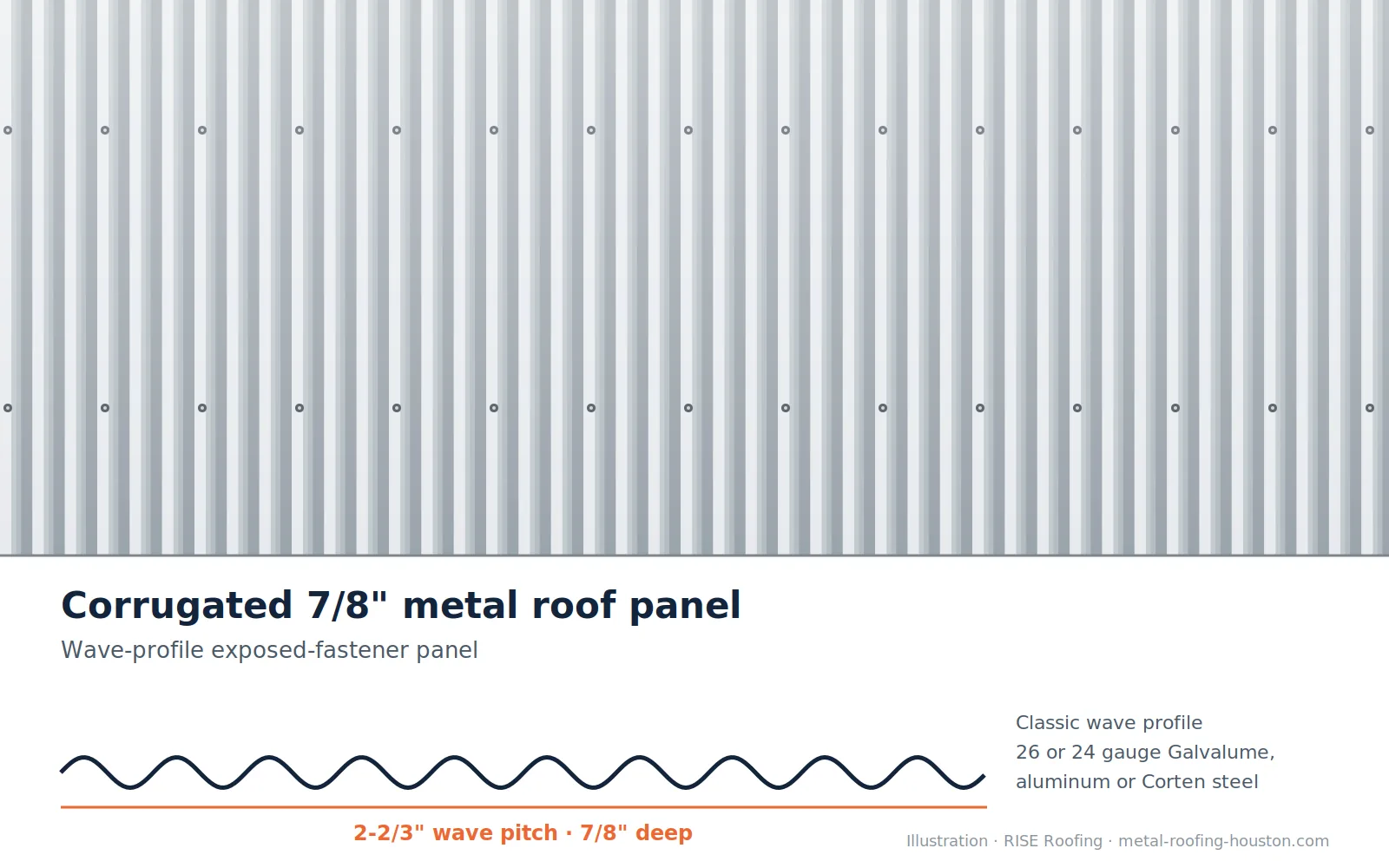
Corrugated panels are usually described by the depth of the wave (7/8" or 1/2"), though some makers name them by wave spacing instead (a "2-1/2" corrugated" panel is 1/2" deep). The panel illustrated above is 7/8" corrugated: a round wave every 2-2/3", 7/8" deep. 1/2" corrugated is the shallower wave; one maker sells it as a "light duty" panel with 29 gauge as standard.
| Spec | 7/8" corrugated | 1/2" corrugated |
|---|---|---|
| Wave spacing (crest to crest) | 2-2/3" (2.67") | About 2-1/2" |
| Wave depth | 7/8" | 1/2" |
| Gauges makers list | 26, 24, 22, 20 | 29 (standard), 26 |
| Roof coverage per sheet | About 34-2/3" | About 21-1/3" (laps two ribs on a roof) |
Figures are examples from manufacturers' data sheets; check the sheet for the panel on your quote. The deeper 7/8" wave is stiffer, so it spans further between purlins, and its wider sheets mean fewer side laps. Make sure every quote names the wave depth and the gauge.
R-panel (also sold as PBR) is the other exposed-fastener workhorse on Houston barns, shops and warehouses:
| Corrugated (7/8") | R-panel (PBR) | |
|---|---|---|
| Shape | Round waves 7/8" deep every 2-2/3" | Ribs 1.25" tall every 12", flat pans between |
| Roof coverage per sheet | About 34-2/3" | 36" |
| Minimum pitch | 3:12 (our recommended minimum) | 1/2:12 with sealant in the laps |
| Typical use | Barns, workshops, ADUs, carports, farmhouse-style homes | Warehouses, commercial and ag buildings, low-slope roofs |
| Installed cost | Our lowest-priced metal profile | A step up per square foot |
Both use exposed screws with EPDM washers and need the same kind of re-seal pass. For reference, the residential code's minimum for lapped metal panels is 3:12 without lap sealant and 1/2:12 with sealant applied per the maker's instructions. Full specs are on our R-panel page.
5V crimp is the third exposed-fastener option, with 24" V-ribbed panels popular on historic and farmhouse roofs. Standing seam hides its fasteners under the seams and costs more; see exposed vs concealed fasteners.
Gauge: the lower the number, the thicker the steel. 26 gauge (about 0.018") is the standard; 24 gauge (about 0.024") resists dents better and spans further, and it's our default in hail-prone areas. We quote both. Light-duty 29-gauge corrugated is thinner than either. More in our gauge guide.
Coating: the residential code requires steel roof panels to carry a corrosion-resistant coating, such as 55% aluminum-zinc (Galvalume, ASTM A792 AZ50) or G90 galvanizing (ASTM A653). Painted corrugated comes in SMP or Kynar 500 (PVDF) finishes; see metal roof colors.
Rust starts where that coating is cut or attacked: unprimed cut edges, metal shavings left on the panels, contact with copper or lead, and salt air. Aluminum doesn't rust, so close to salt water we recommend aluminum standing seam; we don't install aluminum corrugated.
On a house: the residential code calls for underlayment, and for solid or spaced sheathing under metal roof panels unless the panel is designed for spaced supports (2021 IRC R905.10, as adopted by the City of Houston). Over solid decking, underlayment and attic insulation, a metal roof is no louder than shingles in the rain. The bigger hurdle is often the HOA (see below).
On a barn or shop: 7/8" corrugated can run over open purlins, one reason outbuildings price lower. In a maker's load table, allowable loads drop as spans grow and thinner steel needs closer supports, so take the spacing from the table for your gauge. Bare panels over open framing can drip condensation without a thermal break, such as rigid foam between the purlins and panels; see metal roof insulation.
Wins: barns and workshops in Cypress, Tomball, and Hockley; ADUs, garage apartments, and pool houses; carports and porte-cocheres; farmhouse-modern remodels where the wave pattern is part of the aesthetic; and any project where the roof is a budget line item that has to come in under $7/sq ft.
Doesn't win: anywhere an HOA explicitly prohibits visible corrugated panels (most master-planned communities — use DECRA instead); roofs below 3:12 pitch (use mech-lock standing seam); and TWIA Tier-1 high-velocity zones where the exposed-fastener pattern fails wind uplift testing without engineered fastening (we'll spec a different profile).
Whether you do it yourself or hire it out, these details decide whether the roof stays dry:
Hiring it out? We handle the permit paperwork, send a written, price-locked quote within 24–48 hours, and back the install with our 10-year workmanship warranty. Start on our contact page.
Corrugated is exposed-fastener — neoprene-washered screws penetrate every panel. Those screws have a service life of 10–15 years in Houston's heat-cycle climate before the EPDM washers harden and shrink. Plan on a fastener inspection and re-seal at year 12; budget roughly $0.80–$1.20/sq ft for that pass. Write down the install date so that pass doesn't slip, and book it sooner if you spot backed-out or crushed screws.
Get a written corrugated quote with substrate and gauge specified for your specific project: (832) 345-9527.
Neither wins everywhere. R-panel suits warehouses, commercial and ag buildings, and low-slope roofs down to 1/2:12 with sealant in the laps. Corrugated suits barns, workshops, ADUs and farmhouse-style homes at 3:12 and steeper, and it's our lowest-priced metal profile. Both need a periodic screw re-seal.
26 gauge is the standard for most barns, shops and homes. 24 gauge is thicker, resists dents better and spans further, and it's our default where hail is a concern. Light-duty 29-gauge corrugated is thinner than both. We quote corrugated in 26 and 24 gauge.
Coated steel resists rust, but it can rust at unprimed cut edges, under metal shavings left on the panels, where it touches copper or lead, and in salt air. Close to salt water, aluminum standing seam is the safer choice because aluminum doesn't rust. Corten weathering steel rusts on the surface by design.
Typically 25–40 years. The EPDM washers under the exposed screws wear out much sooner, after 10–15 years in Houston's heat, so plan a fastener inspection and re-seal around year 12. Where a roof lands in that range depends mostly on the coating and how close it sits to salt water.
Industry reference: Metal Roofing Alliance.
No waiting around for multiple contractors to come bid your roof. One quick call is all it takes.
Pick any slot that works for you — online and instant.
Free video or voice call. We answer your questions and gather what we need.
We email your price-locked quote — no pressure, no sales visit.
🔒 Free, no-obligation estimate — Price-locked in 24–48 hrs