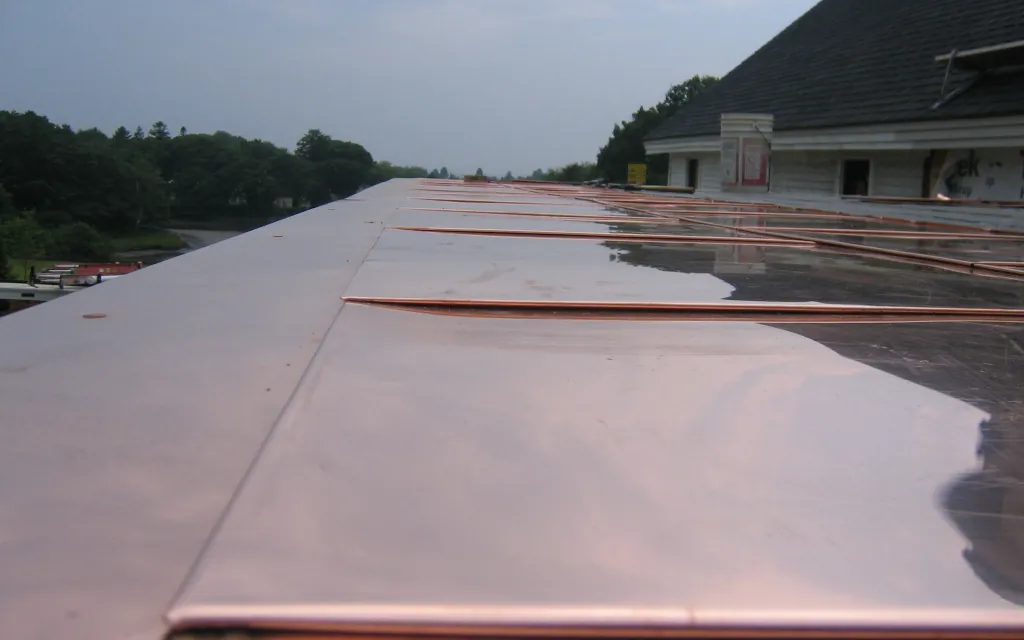
Copper roofing is sheet copper formed into pans and joined with folded seams. There's no paint on it: the color is the metal, and it changes as the roof weathers. RISE Roofing installs copper roofs in Houston. This page covers what to settle before you sign. Technical figures come from the Copper Development Association (CDA) and its Copper in Architecture Design Handbook unless another source is named.
Copper doesn't have to cover the whole house. Copper is also used on smaller roofs, such as dormers, bay windows, porches and cupolas, and for valleys and flashing. CDA says domes and other curved roofs are "readily handled with copper." A small accent roof still sheds water somewhere, though: if it drains onto a metal roof, read the runoff section first. RISE installs both whole copper roofs and copper accent roofs.
| System | How it's built | Sheet weight (CDA) | Where it's used |
|---|---|---|---|
| Standing seam | Pans run down the slope and join at double-locked seams; copper cleats lock into the seams | 16 oz for sheets 18 to 22 inches wide; 20 oz for 24 to 28 inches | Pitched roofs |
| Batten seam | Pans sit between wood battens; copper caps lock over the battens, leaving room for expansion | 16 oz for pans up to 20 inches wide; 20 oz over 24 inches | Pitched roofs |
| Flat seam | Small 18 x 24 inch sheets with folded locks, interlocked both ways | 20 oz | Flat or low-pitch roofs, very steep slopes, domes and curves |
Slope decides a lot. CDA's standard standing and batten seam details call for at least 4 inches of slope per foot where heavy rain occurs; sealant in the seams brings that to 3 in 12. Lower than that, CDA points to soldered flat seam, the only copper system it says "is constructed to be completely watertight."
Copper standing seam works like the painted panels on our standing seam page, but the metal, cleats and fasteners differ, and copper is left bare.
Copper is sold by weight per square foot, not by gauge. Per CDA, 16 oz copper weighs 1.00 lb per square foot and is about 0.0216 inch thick; 20 oz weighs 1.25 lb and is about 0.0270 inch thick. CDA says copper roofing is typically built from 16 oz or 20 oz cold-rolled sheet, the temper it calls "by far the most popular" in construction.
The pattern in CDA's tables: the wider the pan, the heavier the sheet. Flat seam sheets and edge strips are 20 oz; cleats are usually 16 oz. Ask any bidder which weight they're pricing and how wide the pans are.
New copper is bright. CDA says its "warm bronze tones can be expected to lead to the elegant green patina finish." The green film forms as acidic moisture in the air reacts with the copper, then adheres tightly and protects the metal.
How fast? CDA's natural weathering color chart, labeled “typical for moist industrial climates, timespan varies,” runs from new copper to 25–30 years; we won't promise a timetable for your roof. It says patina forms faster in metropolitan, marine and industrial areas, that temperature, humidity, drainage, sun and slope change the rate, and that the north and south faces of one roof can weather differently. Natural patination "usually takes many years to complete."
Painted steel and aluminum get their color from a factory finish instead; see metal roof colors.
CDA says a south-facing copper roof under clear skies with no wind can run 75 to 85°F above the air temperature. Using CDA's expansion coefficient, a 30-foot pan that swings 100°F changes length by about 0.35 inch. The roof has to allow for it:
Inside the Texas windstorm (TDI catastrophe) area, a copper roof has to be built to a TDI-evaluated copper system or an engineered design to get its WPI-8; see Texas windstorm metal roofs.
This matters most with accents. A copper bay roof or dormer that drains onto Galvalume, aluminum or galvanized steel can corrode it.
The fix is design: catch the copper's water in a gutter, send it down a downspout that doesn't empty onto the other metal, and keep the metals apart. Our Galvalume vs aluminum page covers those two metals.
Shingle and tile roofs: the risk runs the other way. When a large shingle or tile roof empties into a small copper valley or gutter, CDA says the copper "may deteriorate before it develops a protective patina." Shingles resting directly on copper cause "line-corrosion"; a cant strip under the shingle edge prevents it. On porous stone such as marble or limestone, slow copper drips leave green stains.
RISE handles the permit paperwork for city permits and provides the product sheets and copper samples an HOA committee or the city's historic commission asks for.
We don't publish a copper price per square foot; a small accent roof and a soldered flat seam roof are too far apart for one number. What moves it:
CDA argues copper should be judged on life-cycle cost, which counts maintenance, service life and salvage value. For painted steel and aluminum, see metal roof cost. For copper, RISE prices your roof: a written quote within 24–48 hours, price-locked once you sign.
CDA gives no year count. It says there are "numerous examples of copper roofs which have been in place one or more centuries," and that soldered seams "should last the life of the copper," provided the roof is "properly designed and installed." The failures it warns about are details: fixed cleats on long pans, a missing slip sheet, sealants that attack copper (it names acrylic, neoprene and nitrile) and runoff onto other metals. RISE's workmanship warranty on a roof replacement is 10 years.
We don't publish a per-square-foot figure for copper. Price depends on sheet weight (16 oz or 20 oz), the seam system, any soldering and the roof's complexity. RISE sends a written quote within 24–48 hours, price-locked once you sign.
Copper pans that run down the slope and join at raised, double-locked seams. Copper cleats lock into the seams, so nothing is screwed through the face. Pans longer than 10 feet need expansion cleats.
There is no fixed timetable. The Copper Development Association says patina forms faster in metropolitan, marine and industrial areas, varies with sun, humidity, drainage and slope, and usually takes many years.
It shouldn't drain onto Galvalume, aluminum or galvanized steel: copper salts in the runoff can stain and corrode them. Catch the copper's water in a gutter and carry it away in a downspout.
Yes. RISE Roofing installs copper roofs in Houston, both whole roofs and accent roofs such as dormers, bay windows and porches. Ask about the seam system, sheet weight and drainage for your roof, and you'll get a written quote within 24–48 hours.
Weighing copper roofing for your home? Call (832) 345-9527 for a written quote within 24–48 hours.
Industry reference: Metal Roofing Alliance.
No waiting around for multiple contractors to come bid your roof. One quick call is all it takes.
Pick any slot that works for you — online and instant.
Free video or voice call. We answer your questions and gather what we need.
We email your price-locked quote — no pressure, no sales visit.
🔒 Free, no-obligation estimate — Price-locked in 24–48 hrs